Abstract摘要
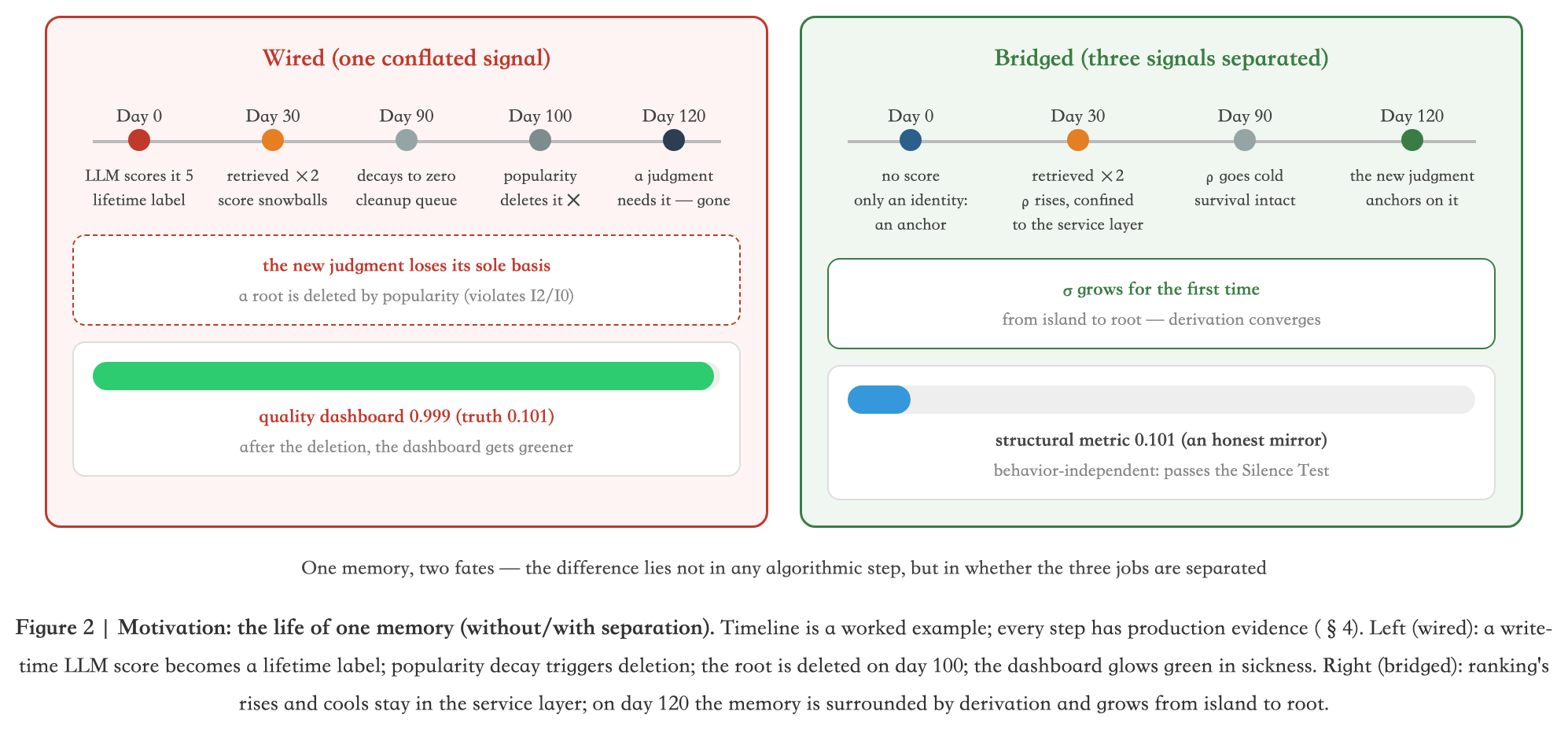
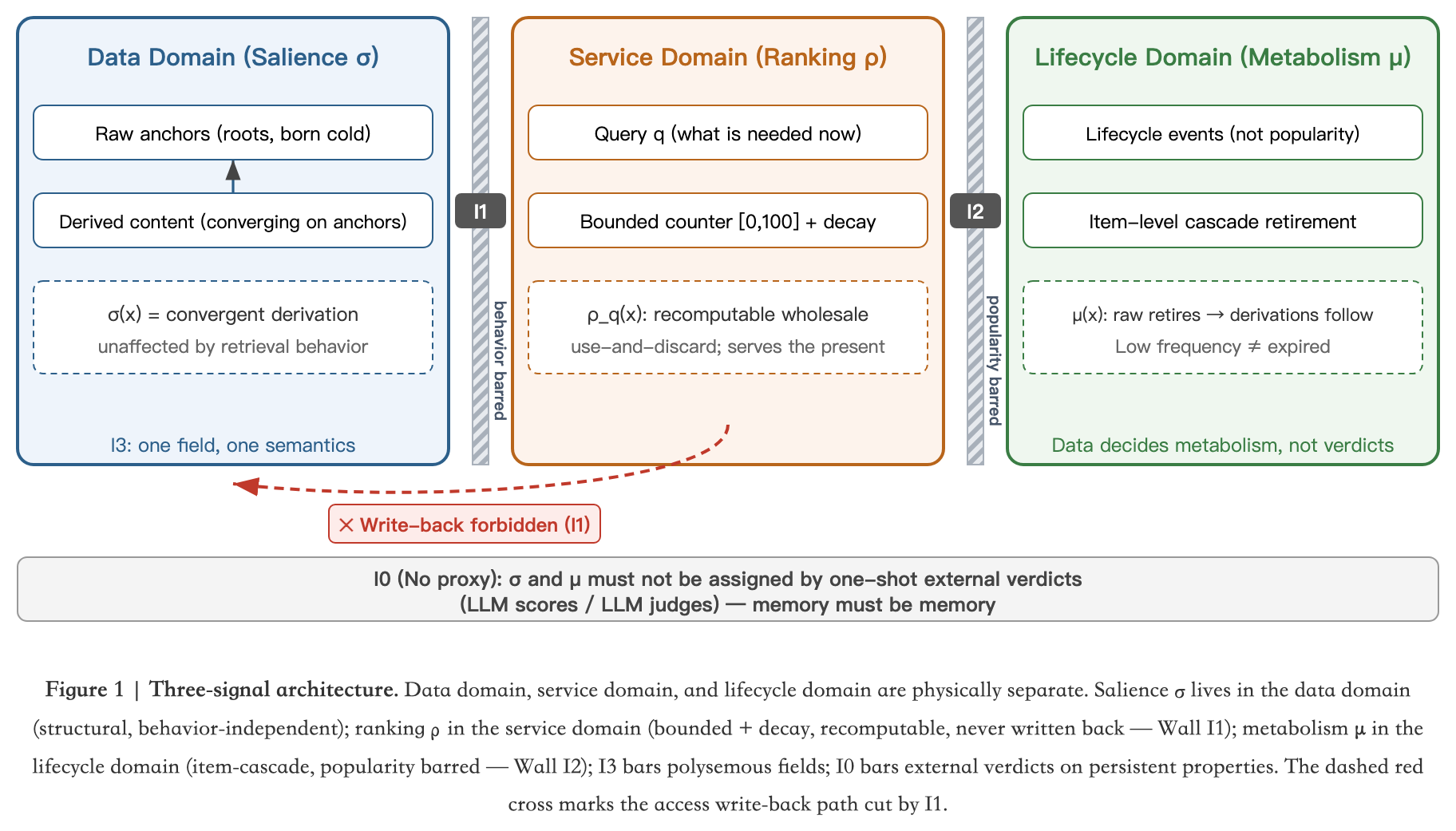
Long-running agent memory systems commonly treat "importance" as a single quantity. We argue that it conflates three distinct signals, and that the conflation is a structural design error rather than an implementation detail. A scoring formula written in 2023 for a simulation demo (relevance plus recency plus importance) moved into production systems unexamined, letting the three jobs of "importance" (sedimentation, ranking, retirement, later separated here as salience, ranking, and metabolism) interfere with one another within a single signal. Our position rests on a service chain: memory serves the LLM; the LLM serves the human. And memory must be memory: self-describing and self-metabolizing, its salience and retirement decided by data and lifecycle rather than one-shot human-delegated verdicts (Invariant I0). Skip the middle link and even the most elaborate memory system drifts toward RAG. Since March 2026, over about seven months of production telemetry on a single conversational system (~38K raw memory items, ~148K association links as of the 2026-08 audit, the live store now holding ~108K), we argue that "importance" is at least three orthogonal signals that are best kept physically separated: salience (intrinsic to the data), ranking (a query-time service), and metabolism (lifecycle retirement). We document three production failures of conflation: a 93× semantic skew inside one counter, a structure-blind quality metric reporting 0.999 while the store's structure-aware coherence read 0.101, and 88% of raw memories being "islands" (73% at the time of writing, still declining without cleanup), yet containing the most structurally central roots. The retrieval-side pressure is measurable: an access-distribution Gini coefficient of 0.960, with the top 1% of nodes absorbing 51.9% of all accesses. We contribute a signal taxonomy with four invariants (I0–I3), seven design laws, and two same-day audit tools (the Silence Test and the RAG Test). No benchmark supremacy is claimed; all evidence comes from our own failures, of which we have plenty.
Key numbers关键数字
The honesty bound诚实边界
Boundary边界
No benchmark supremacy is claimed; all evidence comes from our own failures, of which we have plenty.