Abstract摘要
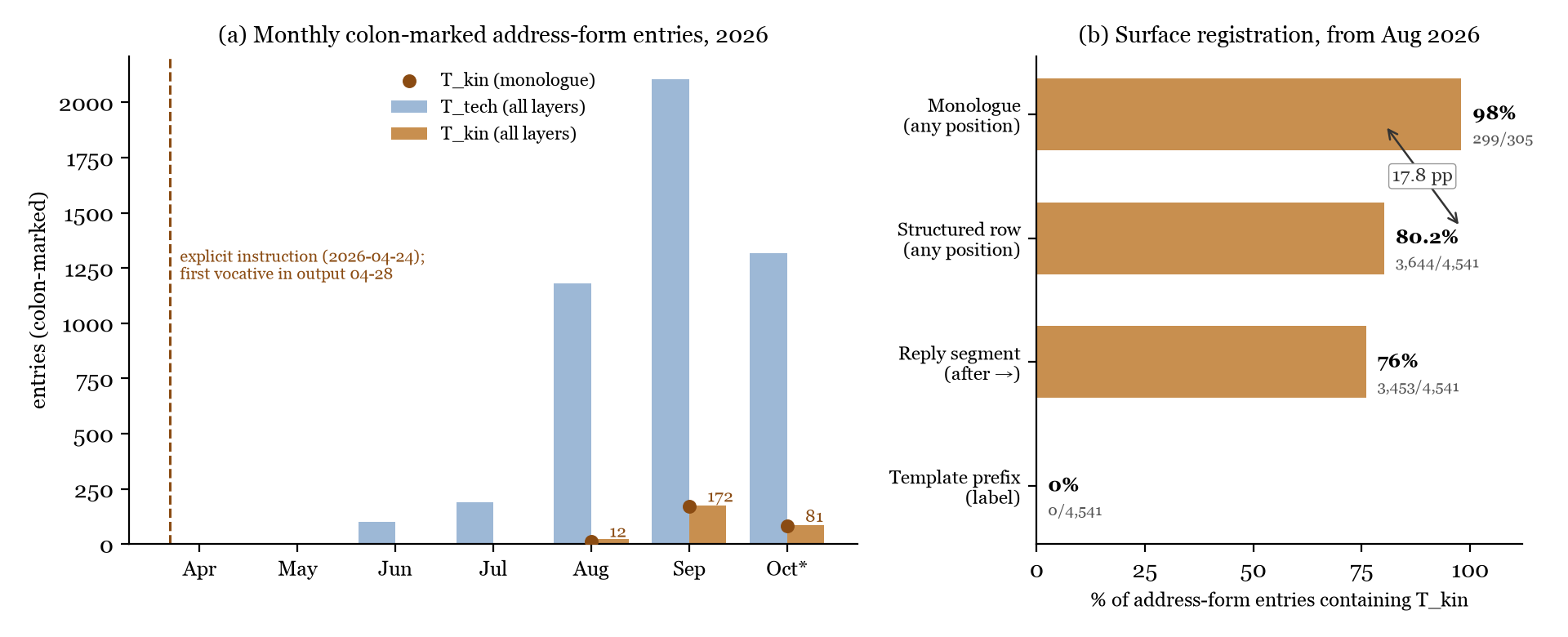
In a personal agent system with persistent memory, in regular daily use (self-report) by a single human, the user instructed the agent in conversation on 2026-04-24 — verbatim, dated, and stored in the corpus — never to address him by the technical label (T_tech, "the user") and to use a kinship-based form (T_kin) or a humor form directly. This paper asks a registration question: which of the system's memory surfaces registered that instruction, and which did not? Five findings. (1) Conversation output registered it within four days: the first kinship vocative appears on 2026-04-28 in the raw-assistant log. (2) The monologue layer (the system's thinking-chain records; the layer begins 2026-08-24) is 90% kinship-containing under the colon-marked rule on its first day (9/10 address-form entries) and 98.0% under the any-position definition (299/305 address-form entries). (3) One structured template row contains two surfaces: the format prefix never registers — all 4,541 rows open with the technical label by format necessity — while the generated reply segment after the arrow in those same rows is 76.0% kinship-containing (3,453/4,541), and 38.8% of the rows open that reply with the kinship vocative (1,760/4,541). (4) The tool-echo surface, observed in a GLM-class lineage that carries the same kind of instruction as a standing system prompt, shows assistant output with 860 kinship-form and zero technical-form occurrences, and tool echoes with 948 against 120 — the technical form survives only inside harness-generated report labels. (5) Under one definition applied to both layers, the monologue layer is 98.0% and the structured whole-row 80.2% (3,644/4,541) — a 17.8-percentage-point gap. In this system registration sorted by surface type — generation surfaces register, format surfaces do not and cannot, echo surfaces carry — while no time course can be established: model-family change co-varies with the whole window. The serving model changed at least three times inside the window (08-16, 08-26, 08-31), so model family co-varies with time completely: the kinship share is 83.3% in the first model period and 86.4% in the last, with 98.9% of monologue records in the final period; the layer differences are co-existing differences, not a gradual-adoption curve. We further document, as a measurement finding, the falsification of three of our own earlier claims — all artifacts of a colon-marked counting rule that could not see comma-form vocatives.
Key numbers关键数字
The honesty bound诚实边界
Boundary边界
Single observational case. The serving model changed three times inside the window, so nothing in the data separates instruction effects from model change; no time course is claimed. Three of our own earlier claims are retracted in the paper as artifacts of a colon-marked counting rule.